
| Listen to this article as a podcast |
You’re sitting on the couch, half-paying attention to the TV, when your phone lights up.
IRS ALERT: Your refund has been flagged due to suspicious activity. Verify your identity within 24 hours to avoid account suspension.
A minute later, another message arrives.
Final notice: Failure to respond may result in delayed processing, penalties, or loss of refund eligibility.
It looks official, and sounds urgent. It’s designed to make you panic before you think. The truth is, that message probably didn’t come from the IRS. It came from a scammer, and today there’s a good chance artificial intelligence helped write it, personalize it, and make it look frighteningly real.
Tax scams are nothing new. Criminals have been impersonating the IRS for years. What has changed is how convincing these scams have become. The IRS’s Dirty Dozen warning specifically highlights IRS impersonations by email and text, as well as AI-enabled IRS impersonations by phone, including robocalls, voice mimicry, and spoofed caller ID. The IRS is also warning taxpayers not to click unexpected links because they often lead to malware, credential theft, or fake IRS-looking websites. That should make everyone a little uncomfortable, because the old advice for spotting tax scams is getting outdated fast.
Why AI tax scams are so dangerous

For years, we told people to look for bad grammar, strange formatting, blurry logos, and obvious misspellings. That used to be decent advice. Scammers were sloppy, and their emails looked weird. Their fake websites were clunky and their messages obviously indicated that something was off.
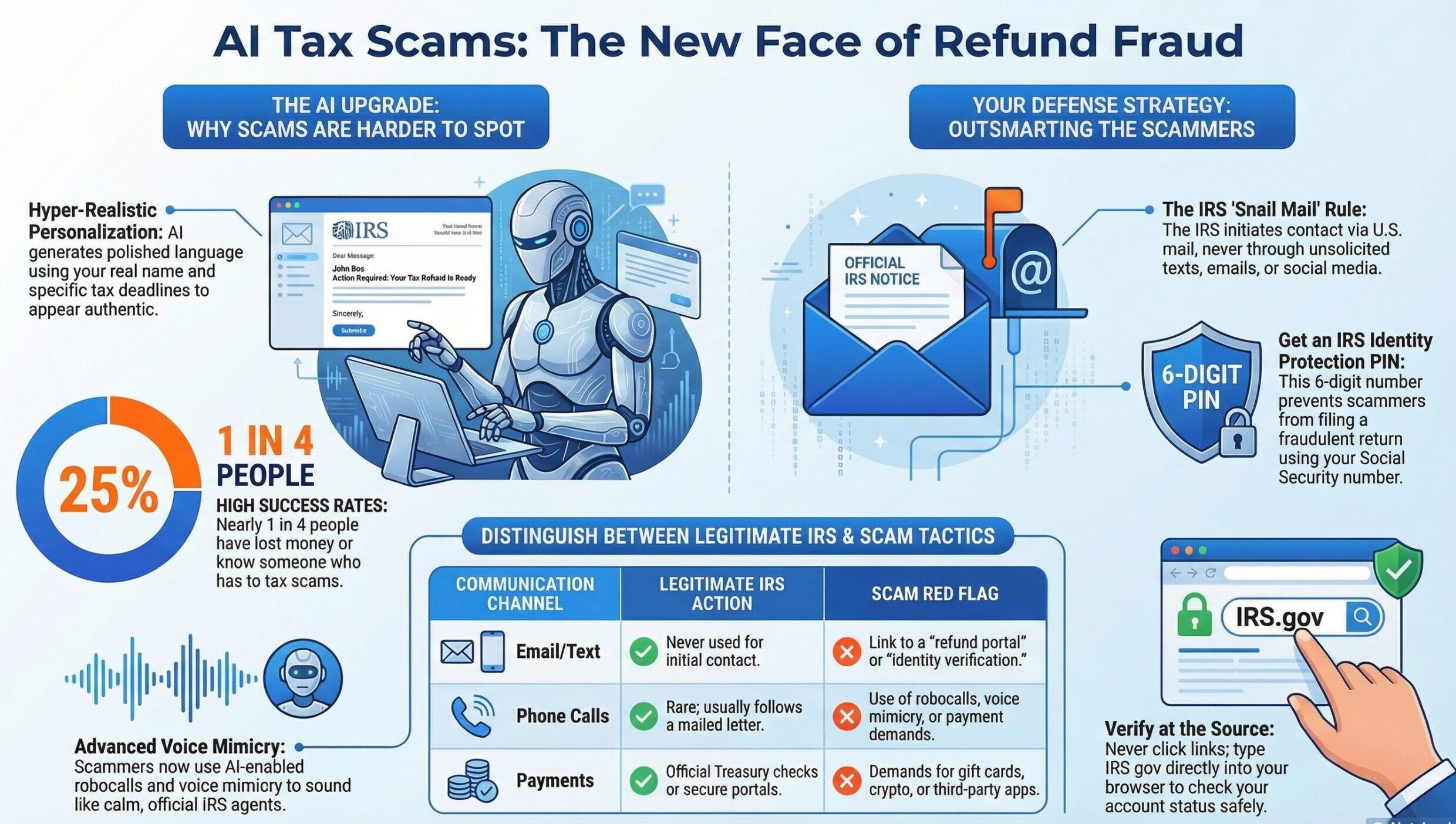
Now, AI helps criminals write cleaner emails, smoother texts, and more believable scripts. It can generate polished language in seconds, imitate official tones, and tailor messages to different audiences. That means that scams today don’t always look like a scam. It might use your real name and reference the real tax filing deadline. It may mention a refund delay, a tax credit, or “account verification” and sounds professional enough that it’s believable.
The IRS says it does not initiate contact with taxpayers by email, text message, or social media to request personal or financial information. If the IRS needs to reach you, it will almost always start by sending a letter through the U.S. mail. The IRS has also separately warned that fake texts may claim to involve tax credits, payments you are owed, or account issues, all to push people toward fraudulent links. So, if you get an unexpected text saying it’s from the IRS and demanding action, it’s almost certainly a scam.
The new face of IRS phishing scams

Modern IRS phishing scams are not just emails from sketchy addresses anymore. They now show up in several forms:
The classic IRS text scam
You receive a message claiming your refund is on hold, your account needs verification, or you qualify for some new tax-related payment. The message includes a link. Click it, and you may land on a fake login page, a fake refund portal, or a site that tries to steal your bank information, Social Security number, or tax software credentials. The IRS warns specifically about phishing and smishing messages that use alarming language and sometimes QR codes to drive taxpayers to fake sites.
The IRS phone scam
This one is getting nastier. The 2026 IRS Dirty Dozen specifically calls out AI-enabled impersonation by phone, including robocalls and voice mimicry. In other words, scammers are now using technology to make fake IRS calls sound more believable. Add caller ID spoofing, and suddenly a victim sees what looks like a government call and hears a voice that sounds calm, official, and confident. That’s a dangerous combo.
Credential theft
Instead of pretending to be the IRS directly, criminals impersonate tax prep platforms, financial institutions, or e-signature services. You get a message asking you to review a document, verify a return, or log in because of suspicious activity. You click. You sign in. Game over. Proofpoint said this week that in 2026 it has already seen more than a hundred tax-themed campaigns involving malware, credential phishing, fraud, and remote management payloads.
The scam you may never see coming: tax identity theft

Sometimes you don’t even have to click anything for a tax scam to work. A criminal who already has your Social Security number and other personal details can simply file a fraudulent tax return before you do. They claim a refund in your name, direct it to their own bank account, and disappear. Then you file your legitimate return and discover the IRS thinks you already submitted one.
This is tax identity theft, and it’s one of the ugliest versions of tax fraud. By the time you discover it, the scammer may already be gone, and your refund is probably already tied up in a bureaucratic mess. The National Taxpayer Advocate shared that one of the best ways to protect yourself from tax-related identity theft is to get an IRS Identity Protection PIN, known as an IP PIN. The IRS says the IP PIN is a six-digit number that helps prevent someone else from filing a tax return using your Social Security number or ITIN. A new IP PIN is generated each year, making it one of the most practical defenses you can use.
Why these tax scams keep working

These scams keep working because they exploit the same three human weaknesses that every good scam targets:
- Urgency. Scammers want you moving fast. Verify now. Respond today. Final notice. Last chance. Limited time. Act before penalties apply.
- Authority. The IRS scares people. So do tax deadlines, legal language, and money problems. Criminals know that a government-sounding message gets attention.
- Confusion. Taxes are already stressful. Many people do not know exactly how the IRS normally communicates. That uncertainty gives scammers room to operate.
AI amplifies all of these by helping scammers sound sharper, move faster, and test more variations of the same con. McAfee recently reported that as tax scams are getting more realistic, almost 1 in 4 people said they or someone they knew had lost money to a tax scam.
How to avoid tax scams

Here’s the practical advice on how you can avoid falling for a tax scam:
- Assume unexpected IRS texts and emails are fake
If a message claims to be from the IRS and wants you to click a link, open an attachment, scan a QR code, or send personal information, treat it as malicious. The IRS says it does not initiate contact this way. - Go to the source yourself
Never use the phone number, link, or login page sent in an unsolicited message. If you need to check something, type the official IRS website into your browser yourself or use an official app or bookmarked page you already trust. The same goes for your tax prep software. - File as early as you reasonably can
The earlier you file, the less time a criminal has to file first using your stolen information. This will not stop every form of fraud, but it can reduce your exposure to refund theft. - Get an IRS IP PIN
This is one of the smartest moves you can make. The IRS says an IP PIN helps stop someone else from filing a return in your name, and a new one is generated each year. - Slow down when a message creates panic
Scammers win when they control your tempo. If a message makes you feel rushed, that is your cue to stop. Panic isn’t proof, it’s bait. - Watch for requests that don’t make sense
Hopefully everyone knows this by now (but scammers wouldn’t keep doing it if it wasn’t working), the IRS is never going to text you asking for gift cards, cryptocurrency, payment through sketchy apps, or passwords to financial accounts. - Report suspicious messages
The IRS says fake IRS, Treasury, or tax-related messages can be reported, and suspicious texts can be forwarded to 7726 (SPAM) to help wireless providers identify and block them. The IRS also provides reporting guidance for scam emails and messages.
What to do if you already clicked or fell for the scam

First, don’t waste time beating yourself up. Scammers are getting very good at this. Move. If you entered a password on a suspicious site, change it immediately, especially if you reuse that password anywhere else. If you entered banking information, contact your bank or credit card company right away. If you shared personal information that could be used for identity theft, start monitoring your accounts and consider a credit freeze or fraud alert. And if the issue involved your taxes specifically, go directly to the IRS site to review identity theft and fraud resources and look into getting an IP PIN.
Fast action can keep a mistake from turning into a disaster. If you’ve already clicked a link or shared personal information with someone you now suspect was a scammer, don’t panic — but move fast. Here’s a step-by-step walkthrough, our full guide to what to do if you’ve been scammed.
The bottom line on AI tax scams
AI is not creating human greed, manipulation, or fraud, it’s just making old scams faster, cheaper, and a lot more believable. That means tax season comes with a new reality. The scam message in your inbox may be polished, personalized, and technically impressive. It may even mimic the look and feel of the IRS or another government institution. So forget the old idea that scams are always obvious. If a tax-related message shows up out of nowhere and tries to push you into clicking, paying, verifying, or panicking, don’t trust it.